Multi9 min read
Ferries of Japan: Slow Travel by Boat to the Hidden Islands
A guide to slow travel in Japan by ferry — from a five-minute hop across a fishing bay to a 24-hour sailing to Ogasawara, and the hidden places you can only reach by sea.
Best time: Year-round (calmest seas: May–October)
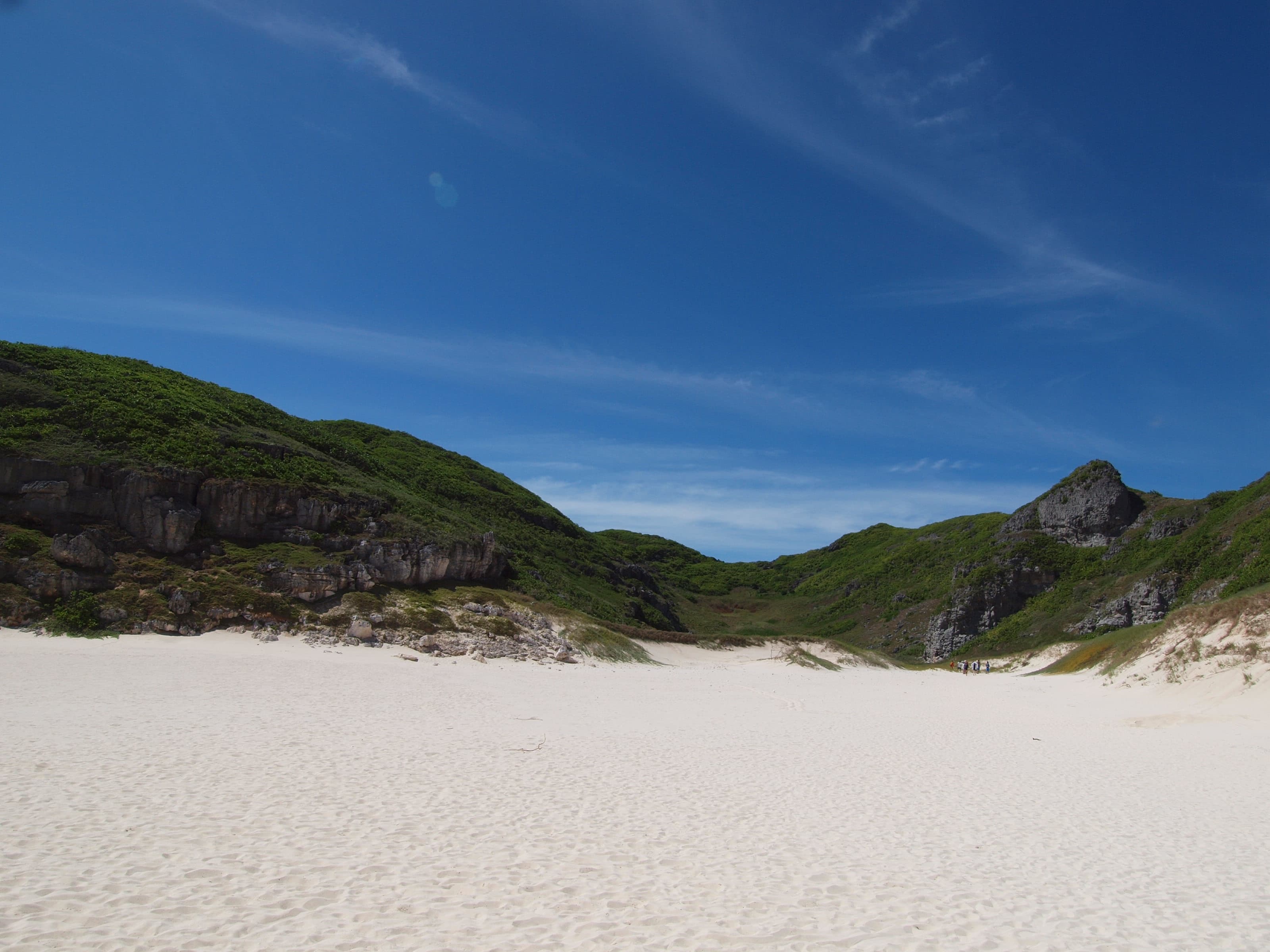
Japan is a country of nearly seven thousand islands, and the shinkansen reaches almost none of them. To get to the other Japan — the one where a village has two hundred cats and no cars, where a church stands alone on an island whose last resident left in 2001, where a lagoon is sealed off from the sea by a limestone arch — you have to go down to a pier and wait for a boat.
That waiting is the point. A ferry is the last form of transport in Japan that cannot be optimised. It goes when it goes, and if the wind gets up it doesn't go at all. In exchange it hands you an hour on an open deck with nothing to do but watch the mainland shrink — and it filters the crowds out for you. Every place below is quiet precisely because of the crossing in front of it. We've ordered them by how far you have to sail. Timetables and fares change — always confirm with the operator before you travel.
01Hiroshimahidden gem
Sensuijima Island — five minutes, and a different world
仙酔島
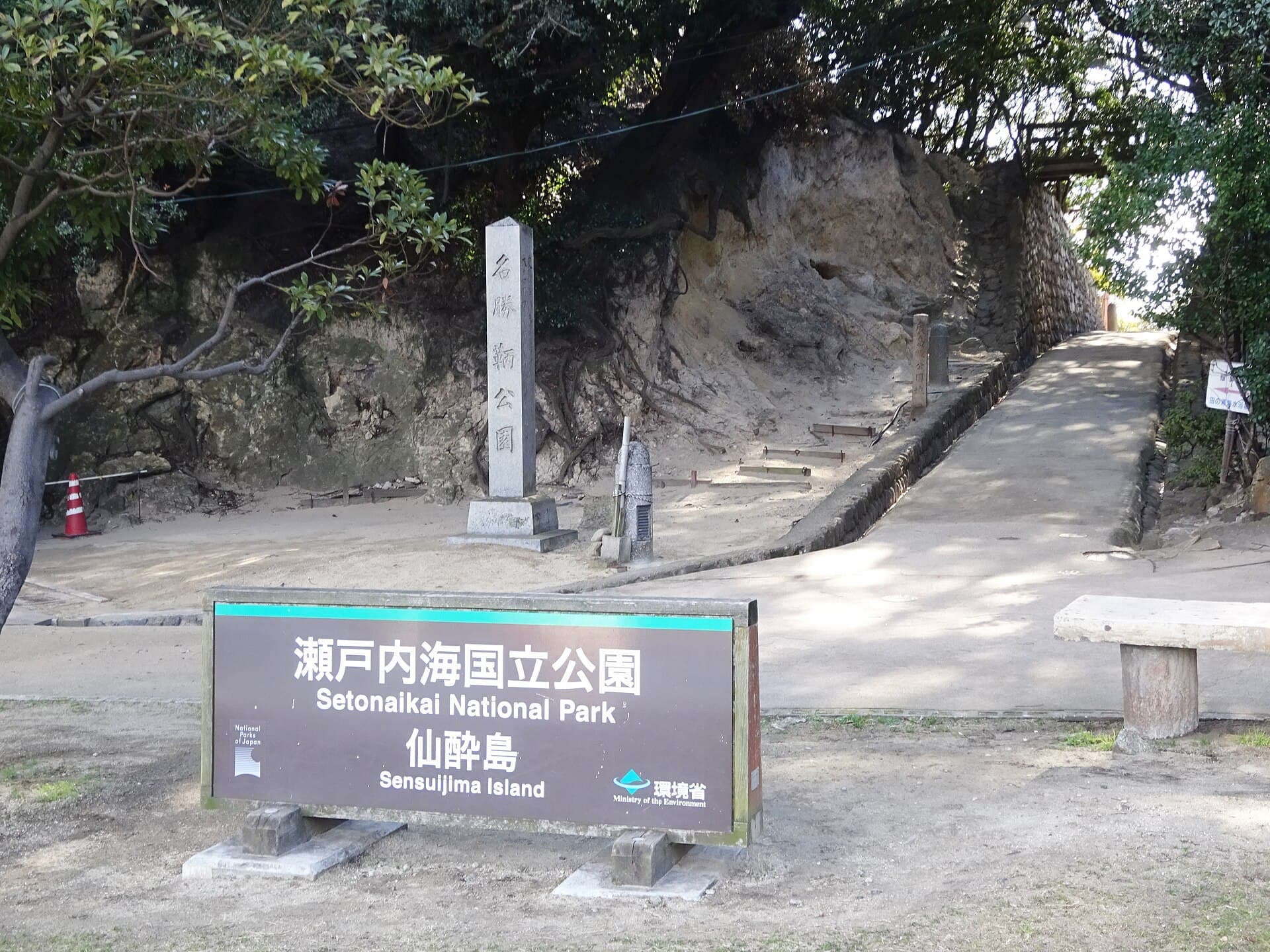
The shortest crossing here is the cheapest possible experiment in what a boat does. Sensuijima is an uninhabited, forested island just off the old port town of Tomonoura, entirely within Setonaikai National Park, five minutes away by boat. On it: a coastal trail past five-coloured volcanic rock formations, a mineral-rich hot spring, and a quiet swimming beach with almost no development. Most visitors spend the day in Tomonoura itself and never make the hop across, which leaves the trails and beach empty even in peak season.
Getting there: From JR Fukuyama Station's south exit, take the Tomotetsu bus toward Tomo (about 30 minutes) to Tomonoura, then the municipal ferry Heisei Iroha-maru across — around 5 minutes. The island is free; the ferry fare is separate. Late spring to early autumn for swimming and hiking; the coastal trail works year-round.
02Fukuoka
Nokonoshima Island Park — ten minutes from a city of 1.5 million
能古島アイランドパーク
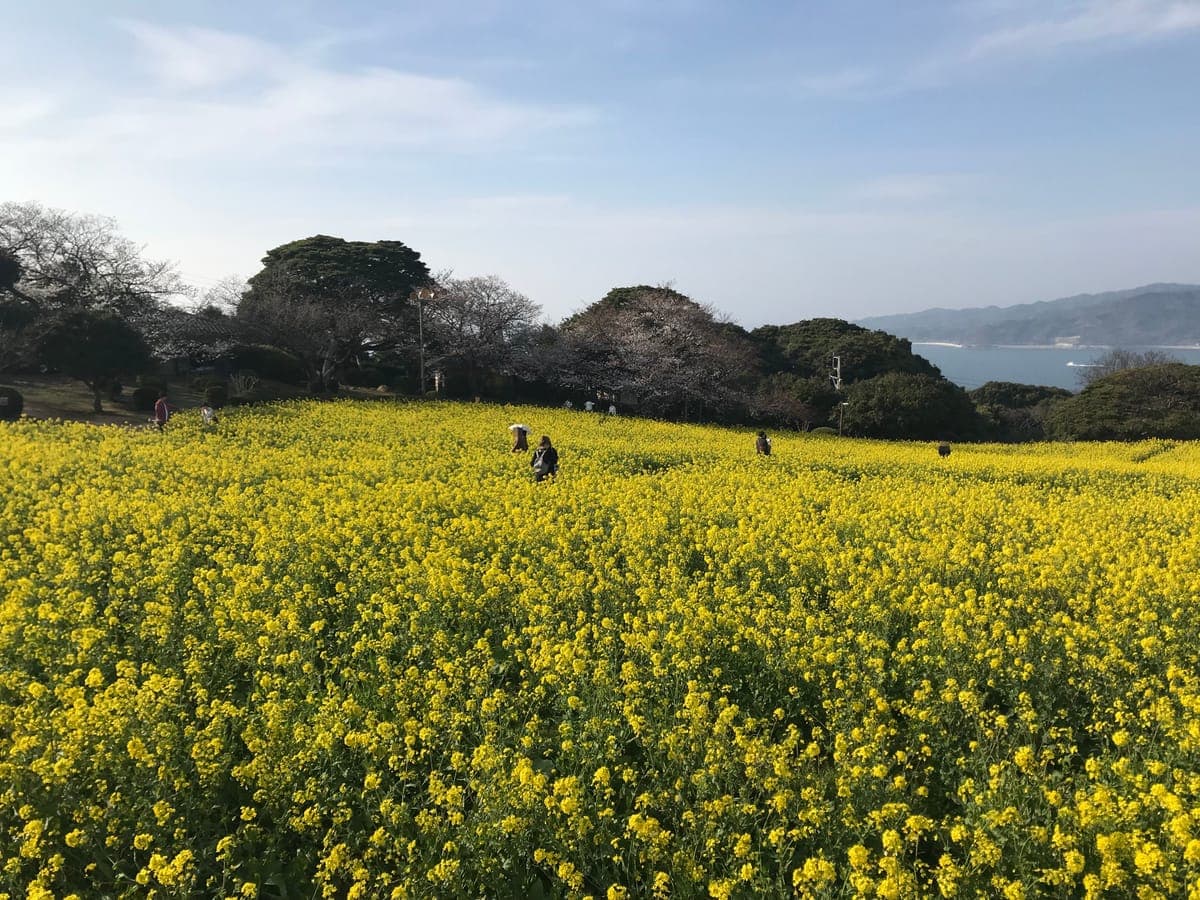
Fukuoka's skyline is still visible from Nokonoshima, and it still feels like an escape — the strange magic of a short crossing. The island's hilltop park is planted with a different flower for every season: rapeseed in late winter, poppies and roses in spring, sunflowers in summer, great carpets of cosmos in autumn. It's one of the most flower-dense parks in Kyushu, on a small island most tourists skip entirely. Ten minutes of open water is apparently enough to put people off, and their loss is your empty hillside.
Getting there: Ferry from Meinohama Ferry Terminal (about 10 minutes), then an island bus up to the park. Park admission ¥1,500 for adults (high-school age and up); the ferry (around ¥230) and the island bus (around ¥240) are separate. Best in spring for rapeseed and poppies, and September–October for the cosmos.
Tokujin Port, Kudaka Island — the only door to the Island of the Gods
Kudaka is the sacred island of the Ryukyus, and it has exactly one way in: Tokujin Port, a small harbour with a village beside it and a handful of daily sailings. That scarcity is the whole character of the place — a tiny working pier that is the single point of arrival for an entire holy island. Rent a bicycle beside the harbour and the island opens up.
Getting there: Ferry or high-speed boat from Azama Port, Nanjo City (about 15–25 minutes); Azama Port is roughly 40 minutes by car from Naha. Ferries run several times daily — check the Kudaka Kaiun timetable. The port is free to enter; the ferry fare is a transport cost, not an admission. Year-round.
03Hyogohidden gem
The Ieshima Islands — thirty minutes from Himeji Castle
家島諸島
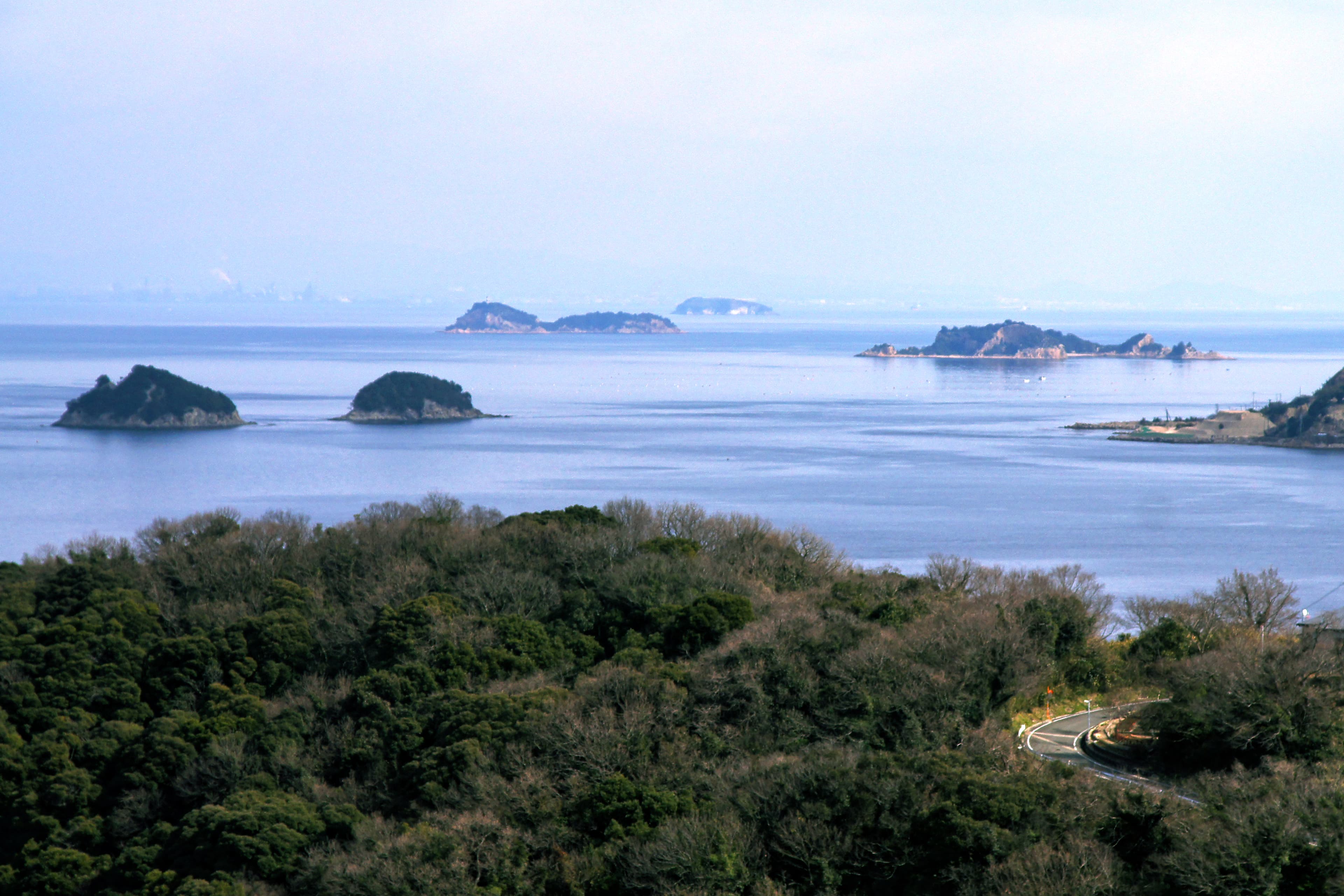
Almost everyone who comes to Himeji comes for the castle, sees the castle, and leaves. Meanwhile a chain of about 40 small islands sits out in the Harima-nada Sea. The largest, Ieshima, is a working fishing town of narrow lanes, seafood restaurants and quiet beaches that castle day-trippers never see. Thirty minutes of sea separates one of Japan's most photographed monuments from one of its least photographed island towns.
Getting there: Bus or taxi from Himeji Station to Shikama Port (about 20 minutes), then a ferry (about 30 minutes) to Ieshima's main port town. Free to visit; the ferry fare is roughly ¥1,540 round-trip for the standard service.
04Kagawahidden gem
Ogijima — forty minutes, two hundred cats
男木島
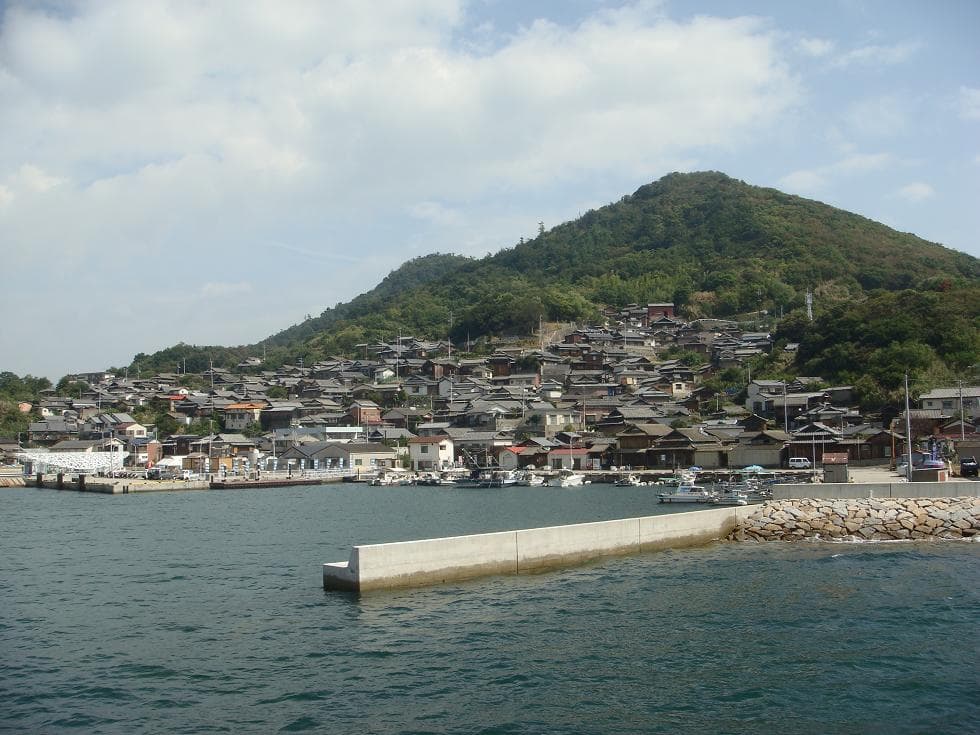
Ogijima is a tiny, near-carless fishing island in the Seto Inland Sea, part of the same Setouchi Triennale chain as Naoshima and Teshima — but living in their shadow, with a fraction of their visitors. You step off the boat beneath Jaume Plensa's white-shell ferry terminal, Ogijima's Soul, and steep whitewashed lanes wind uphill past scattered artworks and roughly 200 free-roaming cats to a lighthouse and a forested summit. No cars, no queue: a walkable island where the ferry timetable is the only clock that matters.
Getting there: Five-minute walk to Takamatsu Port ferry terminal, then the ferry (Shiyujima Kaiun line) to Ogi Port — around 40 minutes, ¥510 one-way, running roughly every two hours. The island itself is free to roam.
05Shigahidden gem
Chikubushima — the boat-only island in a lake
竹生島
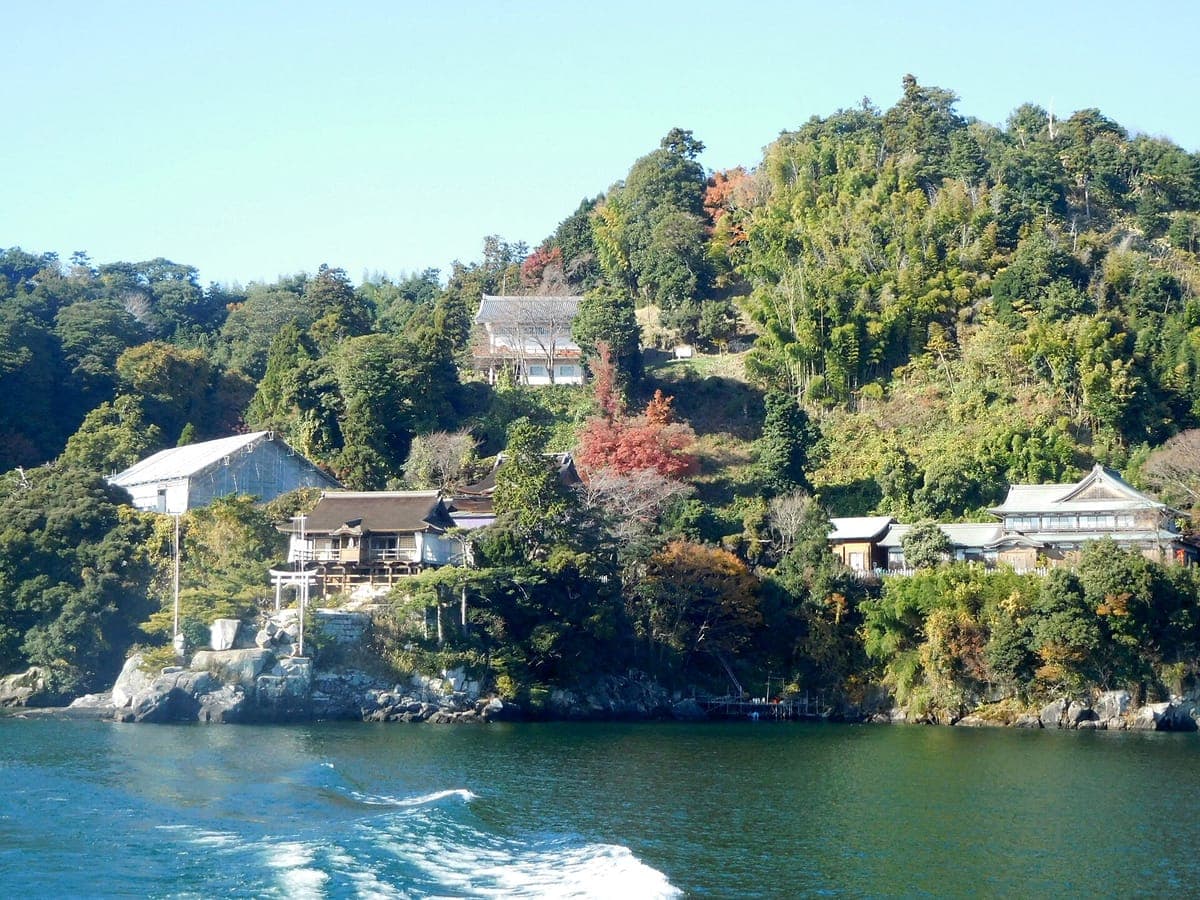
Not every crossing in Japan is a sea crossing. Chikubushima rises steeply out of Lake Biwa and is reached only by boat — no bridge, no causeway, no other way on. Stone steps climb from the landing past Hōgon-ji temple to the ornate Tsukubusuma Shrine, where you throw a small kawarake clay disc through a torii standing in the lake and hope it carries your wish. An ancient island of gods, kept quiet by the simple fact that you cannot drive to it.
Getting there: Boat from Nagahama or Hikone. A ¥600 adult island landing fee is collected on arrival (Hōgon-ji is free to enter; the treasure hall is +¥300); the boat fare is separate. Open 9:30–16:30. Spring through autumn — the sailings are weather-dependent.
06Kumamotohidden gem
Goshoura Cretaceous Museum — a sea-taxi to the dinosaurs
天草市立御所浦恐竜の島博物館
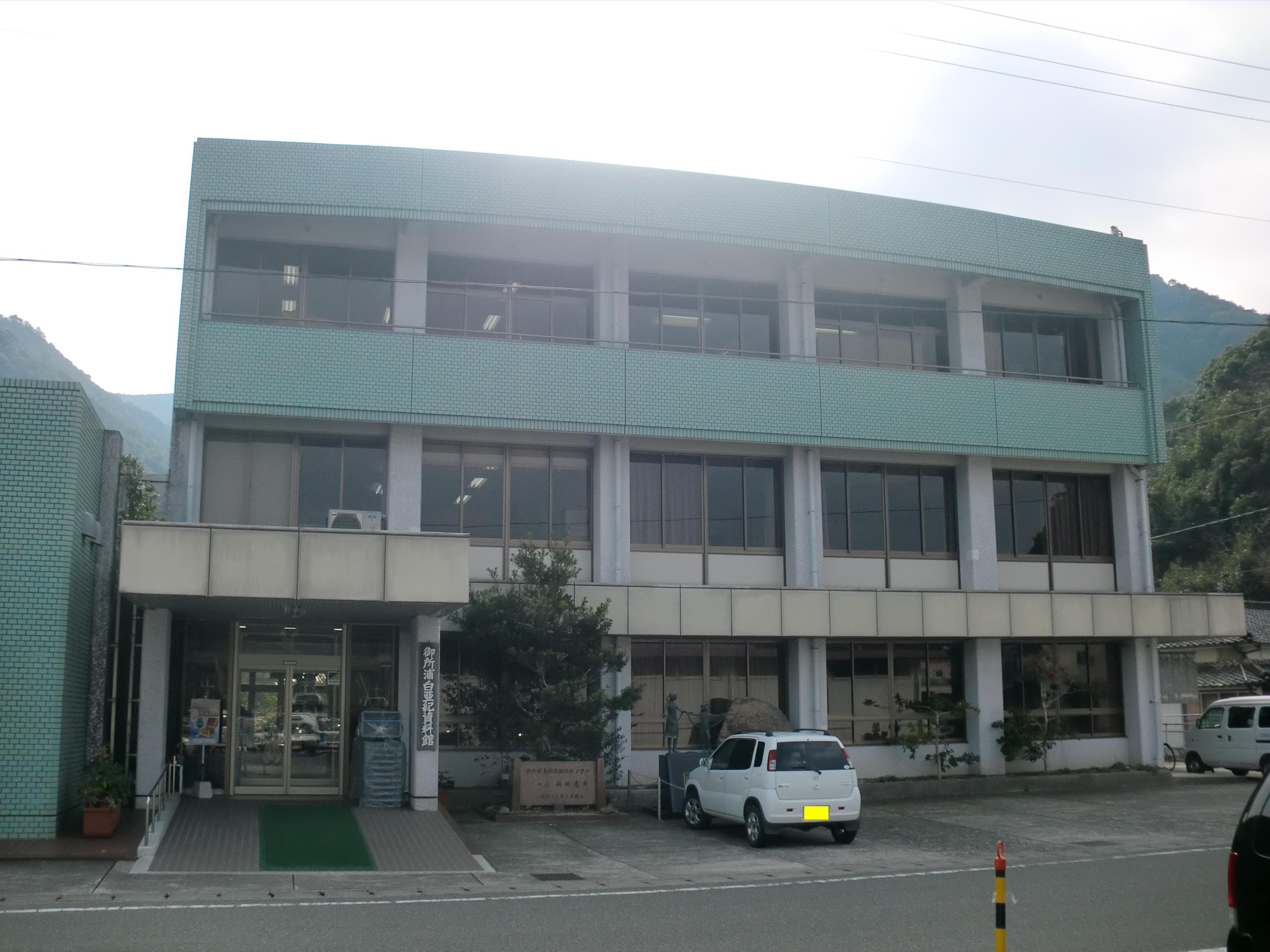
Goshoura is a small island in the Amakusa archipelago that most visitors never reach, because reaching it means committing to a dedicated crossing. On the far side is one of the more unexpected museums in Japan: a three-storey natural-history museum, reopened in March 2024, displaying around 2,000 Cretaceous fossils dug up on the island itself — plus an adjacent dig site where you can hunt for your own, free. The kind of place that survives by being hard to get to.
Getting there: Ferry, car ferry or sea-taxi from Tanasoko Port, Hondo Port (Amakusa City), Daido Port (Kamiamakusa City), or Minamata Port to Goshoura Port, then a short walk. There is no parking on the island for regular visitors — come as a foot passenger. Museum admission ¥500 adult (¥300 high school/university, ¥200 elementary/junior high); open 9:00–17:00, closed Mondays.
07Nagasakihidden gem
Former Nokubi Church, Nozaki Island — a boat to an empty island
旧野首教会
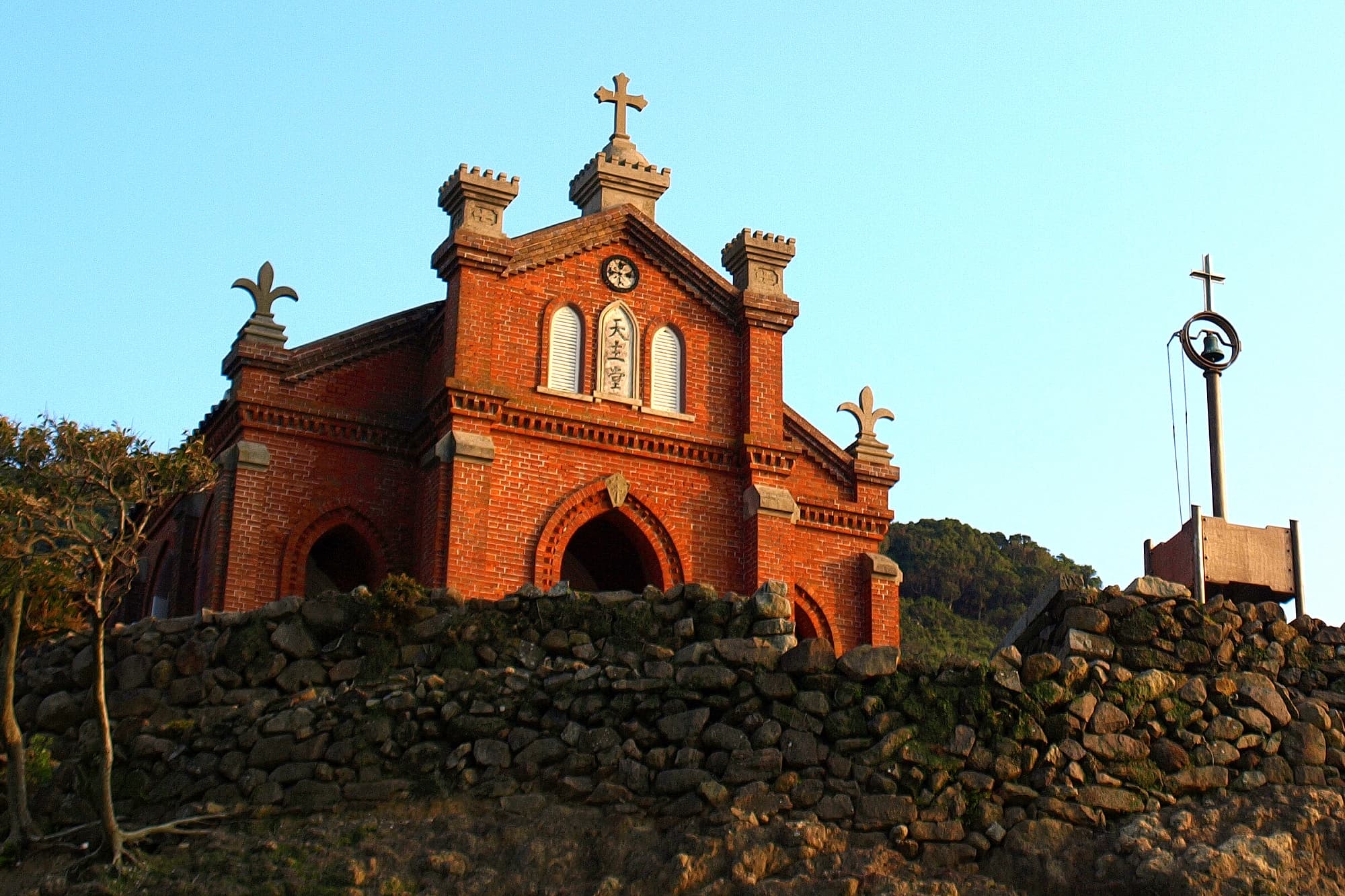
This may be the hardest place in our database to stand in front of. Nozaki Island is completely uninhabited — the last residents left in 2001 — and alone on it stands a brick church built in 1908 by the master church architect Tetsukawa Yōsuke, freshly out of a three-year restoration and reopened in December 2025. Getting there is a two-stage boat journey: a ferry to Ojika Island, then the town-run boat Hamayu across to an island with no residents and no services. You leave on the boat you came on.
Getting there: Ferry to Ojika Island, then the town boat Hamayu to Nozaki (¥520 one-way, twice daily; no boat reservation needed). The church is normally locked — a day visit needs a reservation through Ojika Island Tourism, with a ¥1,000 facility-use fee. Arrange it before you go; there is nothing on the island if you get this wrong.
08Tokyohidden gem
Jinata Onsen, Shikinejima — the night ferry and a hot spring in the rocks
地鉈温泉
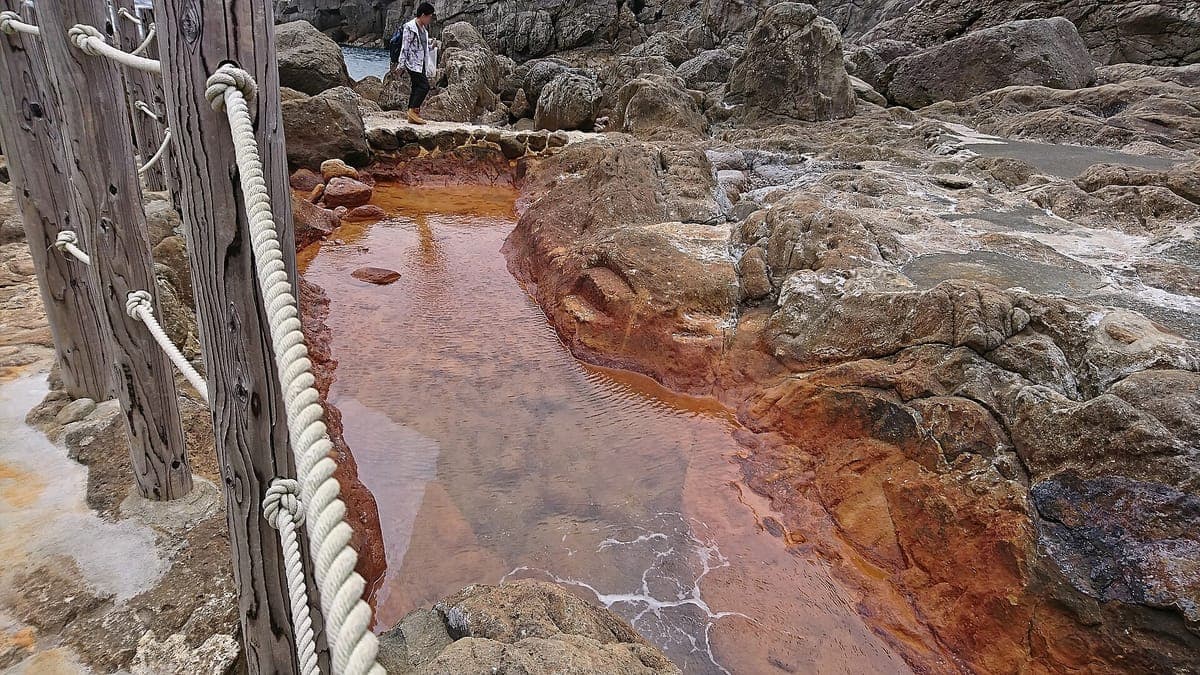
Take the night ferry out of Tokyo and wake up somewhere that does not feel like Tokyo at all. Shikinejima is a tiny Izu island, and at the foot of a ravine on its coast, iron-rich hot water collects between volcanic rock walls and mixes with the incoming sea. It's free, it's open around the clock, and it's batheable near low tide — the sea, not you, sets the schedule. Known mainly to onsen devotees, it is the whole case for an overnight sailing: you fall asleep on a boat and wake up in a hot spring made of tide.
Getting there: Ferry from Tokyo to Shikinejima; from the port and village it's a 20–25 minute walk down a rocky path to the spring. Go at low tide. Free, 24 hours, year-round.
Minamijima Islet — twenty-four hours at sea
And then the crossing that beats them all. The Ogasawara Islands are Tokyo's UNESCO World Natural Heritage archipelago, far out in the Pacific, and there is no airport on Chichijima. The only way in is the Ogasawara-maru: a 24-hour ferry from Takeshiba Pier, departing roughly every six days — so the shortest possible Ogasawara trip is measured in days, not hours. The reward is Minamijima, an uninhabited islet off Chichijima's southwest coast whose Ogi-ike lagoon sits behind a natural limestone arch, a turquoise tidal pool sealed off from the open sea. It is fiercely protected: 100 visitors a day, two hours per visit, closed November to February so the island can rest.
Getting there: The 24-hour Ogasawara-maru ferry from Tokyo's Takeshiba Pier to Chichijima, departing roughly every six days. From Chichijima, a licensed operator runs boat or sea-kayak trips out to Minamijima. There's no entrance fee, but access requires a certified Ogasawara nature guide — commercial tours run roughly ¥9,000 (half-day) to ¥14,000 (full-day). Closed to visitors November–February.
Riding ferries in Japan
The sea decides, not you. Island services are cancelled for wind and swell with no ceremony and no compensation, and the smaller the boat, the lower the threshold. Never put an island last before an international flight, and never build a trip where a single crossing has to work. Leave a day of slack. Typhoon season bites hardest; May to October gives the calmest water.
Go as a foot passenger. Nearly everything here is better without a car: the villages are walkable, and Goshoura has no visitor parking at all. Foot fares are cheaper, and you get the deck instead of the car hold.
Book ahead in summer, and for the long hauls. Peak sailings fill, and a boat that leaves every six days has no fallback. Where a landing needs a guide or a reservation (Minamijima, Nozaki), arrange it before you leave the mainland — and check the return sailing the moment you land. The commonest way to get stranded is assuming there's a later one.
Keep exploring
- Japan's Secret Islands: Gotō, Yakushima, Amami & Sado → — the bigger offshore names, several of them ferry-only.
- Japan by Local Train: Scenic Slow Lines & Country Stations → — the same slow-travel logic, on rails.
- Setouchi: Art Islands & Inland-Sea Port Towns → — more Inland Sea hopping, where Ogijima's neighbours live.
- Okinawa's Outer Islands for Beginners → — how to string together the southern crossings.
Ready to plan? Build your own hidden-Japan itinerary → — our trip generator turns any of these spots into a day-by-day route.